
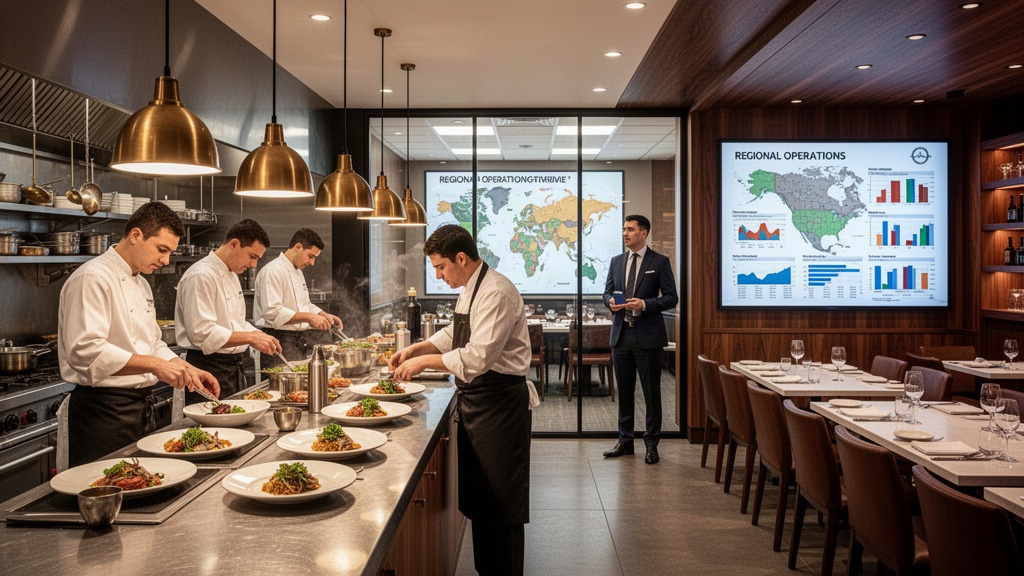
Running a restaurant chain is one of the most demanding ventures in the food service industry. It demands far more than good recipes and a recognizable logo — it requires disciplined systems, financial clarity, and the ability to replicate quality across every single location. Whether you are operating three units or planning to reach thirty, the gap between a thriving multi-location brand and a struggling one almost always comes down to process and preparation. The National Restaurant Association consistently identifies operational consistency and leadership development as the defining factors behind long-term growth. Before signing another lease or hiring another manager, every operator should have a clear roadmap.
- Step 1: Define your concept, brand promise, and growth model
- Step 2: Build profitable unit economics before expanding
- Step 3: Standardize operations without losing local relevance
- Step 4: Recruit leaders and build a scalable technology stack
- Step 5: Manage compliance, labor, and legal obligations proactively
- Step 6: Drive customer loyalty through digital channels
- Step 7: Scale through disciplined performance management
Define the concept, brand promise, and growth model
Every successful multi-unit operation starts with a question most operators underestimate: what exactly are we selling, and to whom? A strong concept is not just a menu — it is a set of decisions about price point, service format, physical footprint, and the emotional experience a guest should walk away with. Clarity here makes every subsequent decision faster and cheaper.
The growth model deserves equal attention from day one. Operators typically choose between company-owned restaurants, franchising, or a hybrid approach. Company-owned units give you direct control over quality and culture, but they demand more capital and management bandwidth. Franchising lets you scale faster with lower capital exposure, but it introduces a new layer of relationships, legal obligations, and brand risk. The Federal Trade Commission requires franchisors to provide a Franchise Disclosure Document before any agreement is signed — a document that governs royalties, territory rights, marketing contributions, and operational standards in detail.
Your target customer profile shapes everything from portion size to parking requirements. A fast-casual concept targeting weekday lunch crowds needs a completely different unit design than a family-dining brand built around weekend dinners. Get specific about your guest before you finalize your prototype. Vague positioning leads to inconsistent execution, and inconsistent execution destroys chains faster than bad locations.
Brand promise is the non-negotiable anchor. It answers what a guest can count on, every time, at every location. Write it down. Train to it. Audit against it. Chains that drift from their original promise — usually under pressure to cut costs — rarely recover their identity without a painful and expensive reset.
Build profitable unit economics before expanding
Unit economics is the financial heartbeat of any multi-location food business. Before opening a second location, you need a clear, honest picture of what a single unit earns, costs, and returns. This means tracking weekly sales, prime cost (the combined total of food and labor expenses), occupancy costs, and net operating income with precision.
Read also: What are the bonds and how they secure your investment future
Prime cost is the single most watched metric in professional restaurant management. Most operators target prime cost at or below 60% of revenue, though the exact threshold shifts depending on service format, menu complexity, and real estate market. A fast-food unit in a lower-rent suburban location will carry a very different cost structure than a full-service concept in a downtown urban corridor.
Same-store sales data tells you whether your existing locations are growing organically or simply treading water. Expanding while same-store sales decline is one of the most common and costly mistakes in the industry. Growth should reward a proven model, not paper over a broken one.
Build your financial model around realistic assumptions. Factor in the federal minimum wage floor of $7.25 per hour, but recognize that most states, counties, and cities set higher minimums that will directly affect your labor line. Under the Affordable Care Act, businesses with 50 or more full-time equivalent employees may face health coverage obligations — a threshold that multi-unit operators can cross quickly without realizing it. Get your numbers right before signing a lease, not after.
Standardize operations without losing local relevance
Standardization is what turns a great single restaurant into a scalable brand. Without documented systems, every new location reinvents the wheel — and usually makes different, costlier mistakes. The goal is to capture what works at your best-performing unit and make it repeatable everywhere else.
A food safety plan is the foundation. The U.S. Food and Drug Administration publishes a model Food Code that most state and local health departments use as their baseline. Your documented procedures should cover receiving, storage temperatures, cross-contamination prevention, cooking temperatures, and employee hygiene. These are not optional details — a single foodborne illness incident can shut down a location and damage the entire brand.
Read also: How Palantir Stock Could Thrive in the Coming Years
Recipe documentation goes beyond ingredient lists. It includes prep methods, portion weights, plating standards, and timing. Purchasing agreements with approved suppliers lock in ingredient quality and reduce cost variance across locations. Training materials — videos, checklists, certification programs — ensure that a team member hired in Phoenix receives the same instruction as one hired in Atlanta.
Local relevance is where rigid chains often fail. Allowing limited regional menu variations, supporting community events, or adapting décor to reflect neighborhood character can meaningfully strengthen guest loyalty without compromising brand standards. The trick is defining clearly which elements are non-negotiable and which ones can flex. Draw that line explicitly in your operations manual before a franchisee or regional manager draws it for you.
Recruit leaders and build a scalable technology stack
People, not systems, actually run restaurants. The quality of your unit managers determines whether your standards survive the daily chaos of service. Hiring managers who can coach, problem-solve, and hold teams accountable is more valuable than any software platform. Invest in their development before you need them to lead.
A scalable technology stack becomes non-negotiable once you pass three or four locations. At minimum, you need a point-of-sale system that consolidates sales data across all units in real time, an inventory management tool that tracks usage and flags variances, and a scheduling platform that helps you manage labor costs against projected sales. As you grow, layering in customer data tools and digital ordering capabilities compounds your advantage.
Digital ordering — whether through your own app, third-party delivery platforms, or kiosk terminals — has moved from optional to expected. Operators who integrate these channels cleanly into their kitchen workflow reduce ticket errors and capture incremental revenue. Those who bolt them on as an afterthought create bottlenecks that frustrate both staff and guests.
Read also: Common Mistakes to Avoid When Trading VIX Stock
OSHA regulations set baseline workplace safety standards for food service operations, covering everything from slip hazards to chemical storage. Building compliance into your onboarding process, rather than addressing violations reactively, protects both employees and the business. A culture where staff feel safe and supported is also a culture with lower turnover — and turnover is one of the largest hidden costs in the industry.
Scaling a restaurant chain through disciplined performance management
Growth without measurement is just expansion. Scaling a restaurant chain sustainably requires a performance management system that gives leadership visibility into every unit, every week, without requiring them to be physically present everywhere at once.
Define your key performance indicators before you open your next location. Sales per labor hour, food cost percentage, guest satisfaction scores, and speed of service benchmarks should all have targets and thresholds that trigger review. When a unit underperforms, the data should tell you whether the problem is labor scheduling, food waste, a weak manager, or a location that was simply the wrong choice.
Site selection deserves its own rigorous process. Traffic counts, daytime population, proximity to competitors, parking availability, and lease terms all affect long-term unit performance. A location that looks attractive because of low rent may be underpriced for a reason. Work with commercial real estate professionals who specialize in food service, and involve your operations team before signing anything.
Local marketing at the unit level drives awareness in ways that national campaigns cannot. Grand opening events, partnerships with nearby businesses, and community sponsorships build the kind of neighborhood presence that generates repeat visits. Pair local efforts with a loyalty program that captures guest data, and you create a feedback loop that informs both marketing and menu decisions.
Set a clear checklist of criteria that must be met before each new opening: proven unit economics at existing locations, a trained management team in place, supply chain capacity confirmed, all permits secured. The U.S. Small Business Administration offers guidance on licensing and compliance frameworks that vary by state and municipality. Rushing an opening to meet an arbitrary timeline is a reliable way to start a new location in a hole it may never climb out of. Discipline at the expansion stage is what separates chains that last from those that collapse under their own growth.