Aerospace companies operate at the intersection of cutting-edge engineering, global politics, and environmental responsibility. Few industries carry as much technical complexity or face as many simultaneous pressures. Demand for commercial aircraft is recovering strongly, yet manufacturers struggle to deliver at scale. Defense budgets are rising, yet regulatory and export control frameworks are tightening. The path to net-zero aviation by 2050, as committed by IATA members, requires technology that does not yet exist at commercial scale. Meanwhile, the workforce needed to build tomorrow's aircraft is shrinking relative to demand. The challenges below define the operating reality for the sector right now:
- Supply chain fragility and persistent production ramp-up delays
- Decarbonization pressure and the limited availability of sustainable aviation fuel
- Regulatory complexity across the FAA, EASA, and international bodies
- Cybersecurity threats targeting connected aircraft and industrial systems
- Geopolitical risk and tightening export controls on dual-use technology
- Workforce shortages in engineering, software, and advanced manufacturing
Why aerospace companies are facing a more complex operating environment
The business model of an aerospace company has always rested on long program cycles. A commercial aircraft program typically spans several years between initial design, flight testing, type certification, and full-rate production. That structural reality means decisions made today carry consequences well into the 2030s. What changed is the number of disruptive forces arriving simultaneously, rather than sequentially.
Cost inflation across raw materials, energy, and skilled labor has compressed margins at a moment when airlines are pressing for faster deliveries. The post-pandemic recovery in air travel demand arrived faster than manufacturers anticipated, exposing production systems that had been deliberately slowed or restructured between 2020 and 2022. Boeing and Airbus both publicly acknowledged ramp-up difficulties on their narrowbody programs, with supplier quality and workforce stability cited as primary constraints.
Geopolitical fragmentation adds another layer. The war in Ukraine, ongoing tensions in the Indo-Pacific, and shifting trade policies have forced companies to rethink sourcing strategies that were built on decades of relatively stable international relationships. Titanium supply chains, for instance, were heavily concentrated in Russia before 2022, creating immediate exposure for airframe manufacturers. Diversification takes years and capital.
Defense spending is rising across NATO members and beyond, which creates opportunity for Lockheed Martin, Northrop Grumman, RTX, and GE Aerospace. Yet higher defense budgets do not automatically translate into faster program execution. Government procurement cycles remain slow, and the technical demands of next-generation platforms — hypersonics, directed energy, autonomous systems — push the boundaries of what current industrial capacity can deliver on schedule.
Supply chain disruption and the struggle to scale production
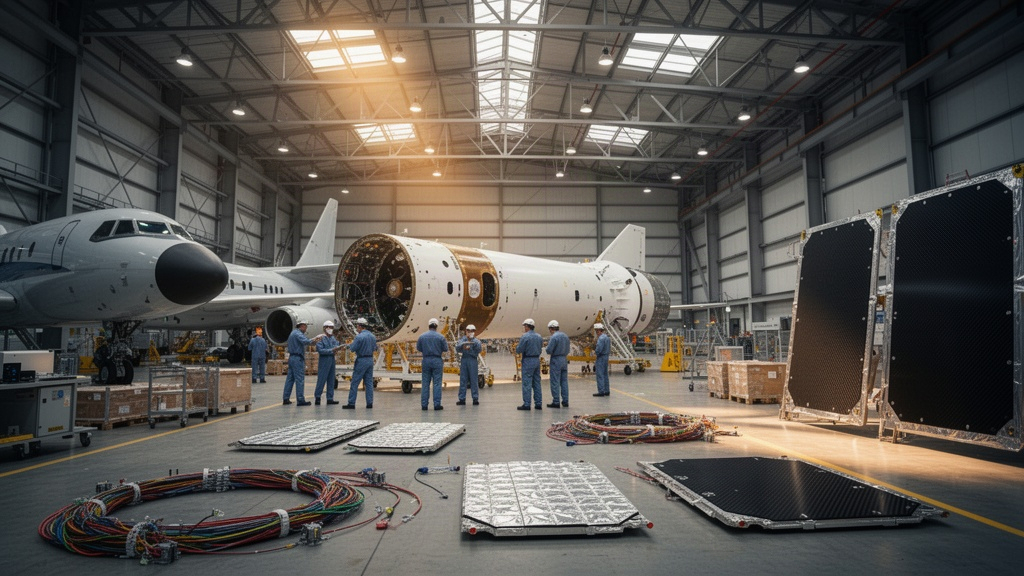
The aerospace supply chain is not a simple two-tier structure. A single commercial aircraft contains hundreds of thousands of parts sourced from thousands of suppliers across dozens of countries. When a tier-3 or tier-4 supplier fails to deliver a specialized fastener or a composite panel on time, the effect propagates upward through the entire assembly sequence. Supply chain resilience has become one of the most debated topics in the industry, precisely because it proved so fragile under pandemic conditions.
Read also: Are You Ready to Learn How to Start Investing Wisely
Recovery has been uneven. Large primes like Airbus and Boeing have the financial resources to absorb some disruption, but their smaller suppliers often do not. Several specialist manufacturers that cut capacity during the downturn have struggled to rehire and retrain workers, creating bottlenecks at precisely the moments when production was supposed to accelerate. The Aerospace Industries Association has flagged persistent tension across engineering, machining, and composites fabrication roles.
Critical materials present a separate challenge. Advanced composites, rare earth elements used in avionics and propulsion systems, and specialty alloys for turbine blades all depend on supply chains with limited geographic diversity. Companies are investing in dual-sourcing strategies and near-shoring initiatives, but these take time to qualify under strict airworthiness requirements. Switching a supplier is not a commercial decision alone — it triggers a certification process that can add months to a program.
Inventory strategies have also shifted. The just-in-time philosophy that dominated aerospace procurement for two decades is giving way to buffer stock approaches that accept higher carrying costs in exchange for production continuity. Digital thread technologies, which link design data to manufacturing and maintenance records across the supply chain, are being deployed to improve visibility and reduce the time needed to identify disruptions before they become stoppages.
Decarbonization pressure and the limits of current technology
Aviation accounts for a meaningful share of global transport emissions, and the sector has made public commitments that now carry regulatory weight. IATA members adopted a net-zero CO2 target for 2050. The International Civil Aviation Organization established a framework for carbon-neutral growth through its CORSIA program. In Europe, the ReFuelEU Aviation regulation mandates minimum blending shares of sustainable aviation fuel: 2% in 2025, rising to 6% by 2030 and 70% by 2050 at EU airports.
The gap between those targets and current production reality is significant. SAF currently represents a small fraction of total jet fuel consumption globally. Production capacity is growing, but feedstock availability, refining infrastructure, and cost parity with conventional jet fuel remain genuine constraints. Airlines are willing to pay a premium for SAF, but not at multiples that make it commercially viable at scale without policy support.
Read also: The secret ingredients of a thriving restaurant chain model
Hydrogen propulsion and full electrification are further out. NASA Aeronautics and several European research programs are investigating hydrogen combustion and fuel cell architectures, but the energy density of hydrogen and the weight of storage systems create engineering trade-offs that have not yet been resolved for long-range commercial flight. Short-haul electric aircraft from companies developing advanced air mobility platforms are closer to certification, but they address a narrow segment of total aviation emissions.
For the near term, the most effective decarbonization tools remain operational efficiency improvements — better air traffic management, continuous descent approaches, weight reduction — combined with progressive SAF blending. These measures reduce emissions without requiring new aircraft types, but they also have physical limits. The sector cannot reach 2050 targets through operational efficiency alone.
Regulatory, cybersecurity and geopolitical risks
Type certification under 14 CFR Part 21 in the United States, or under equivalent EASA frameworks in Europe, is one of the most rigorous approval processes in any industry. The FAA's increased scrutiny following high-profile safety events has extended timelines and added documentation requirements that affect both incumbents and new entrants. Companies developing eVTOL aircraft or novel propulsion systems face certification pathways that are still being defined, adding uncertainty to already ambitious development schedules.
Export controls have become a strategic constraint in their own right. The Bureau of Industry and Security and the Directorate of Defense Trade Controls administer the Export Administration Regulations and ITAR respectively, governing what technologies can be transferred to foreign partners or subsidiaries. As geopolitical tensions have risen, the list of restricted destinations and controlled technologies has expanded. For companies with global supply chains and international joint ventures, compliance requires dedicated legal and technical resources that represent a real cost burden.
Cybersecurity now touches every layer of the aerospace enterprise. Connected aircraft generate and transmit large volumes of operational data. Manufacturing systems run on networked industrial control platforms. Defense contractors hold classified program data that is a persistent target for state-sponsored actors. The U.S. Department of Defense has implemented the Cybersecurity Maturity Model Certification framework, requiring defense suppliers to demonstrate specific security capabilities before winning contracts. Meeting those standards is not trivial for mid-sized suppliers.
Read also: What are the bonds and how they secure your investment future
Technological sovereignty has moved up the agenda for governments in the US, UK, and EU alike. Policies designed to keep sensitive aerospace capabilities onshore are reshaping where companies can invest, with whom they can partner, and how they structure their international operations.
The workforce and innovation challenge for aerospace companies
The talent shortage affecting aerospace companies is structural, not cyclical. An aging workforce in legacy disciplines — structural analysis, propulsion engineering, systems integration — is retiring faster than new graduates are entering the pipeline. At the same time, the industry now competes directly with technology companies for software engineers, data scientists, and cybersecurity professionals who have no particular reason to prefer a defense contractor over a software firm.
The FAA and industry bodies have documented sustained pressure across maintenance, avionics, and advanced manufacturing roles. Apprenticeship programs and university partnerships are expanding, but the lead time between recruiting a student and having a fully productive aerospace engineer is measured in years. Companies cannot solve a 2026 production constraint by hiring a graduate today.
Artificial intelligence and automation offer partial relief. Digital twin technology reduces the physical testing burden during development. AI-assisted design tools accelerate iteration cycles. Automated inspection systems improve quality control throughput without proportional headcount increases. SpaceX and several defense primes have demonstrated that vertically integrated, software-driven development processes can compress timelines that traditional aerospace programs measured in decades.
The deeper challenge is cultural. Aerospace has historically been a conservative industry, for good reason — the consequences of failure are catastrophic. Integrating faster software development cycles with the certification rigor demanded by the FAA and EASA requires new organizational models that most large primes are still working out. Companies that find that balance — moving quickly without compromising airworthiness standards — will define what the next generation of aerospace looks like.