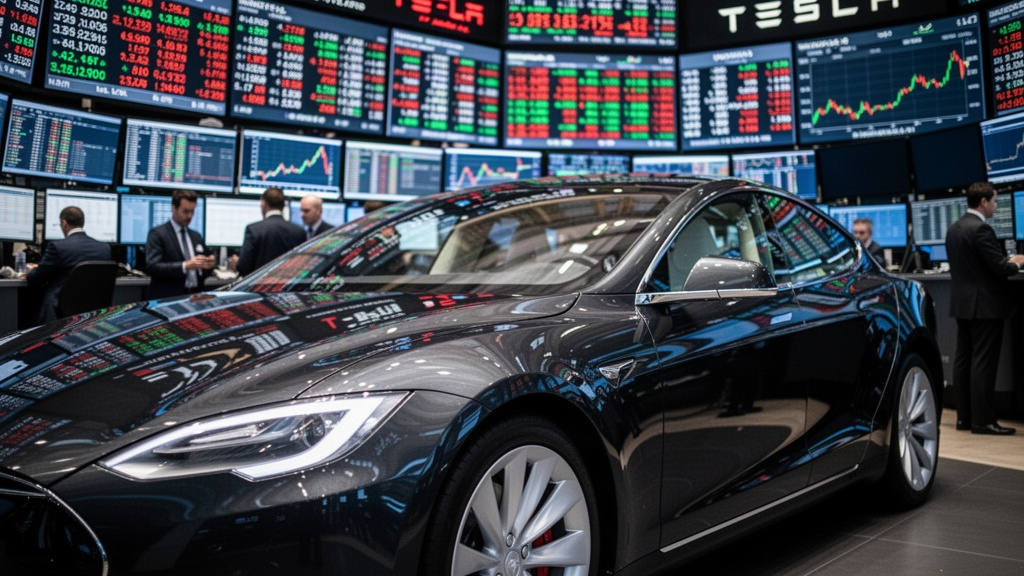
NASDAQ: TSLA is one of the most debated stock tickers on Wall Street, and for good reason. Tesla, Inc. has built a company that defies easy categorization — part automaker, part energy company, part technology platform. With a market capitalization hovering around $800 billion and a stock price near $800 per share, TSLA commands attention from retail investors and institutional funds alike. What separates it from a conventional automotive stock is the sheer breadth of its ambitions: battery storage, autonomous driving software, solar energy, and artificial intelligence all feed into a single publicly traded entity. Understanding why this stock behaves differently from its peers requires looking at the business model, the financials, and the risks with equal honesty.
Understanding Tesla's Market Position
Tesla entered the electric vehicle market when most legacy automakers dismissed battery-powered cars as a niche product. That early positioning gave the company a structural advantage that competitors are still struggling to close. Brand recognition among EV buyers remains exceptionally high, and the Supercharger network — now the largest fast-charging infrastructure in North America — creates a switching cost that is genuinely difficult to replicate quickly.
The company sells vehicles across four main segments: the Model 3 and Model Y for mass-market buyers, and the Model S and Model X for premium customers. The Cybertruck, launched in late 2023, opened a new segment in the pickup truck category, historically dominated by Ford and General Motors. Each launch has expanded Tesla's total addressable market rather than cannibalizing existing lines.
Beyond vehicles, Tesla Energy — which includes the Powerwall home battery and Megapack utility-scale storage — is growing faster than the automotive division on a percentage basis. This matters for investors because energy storage margins tend to be more predictable than vehicle margins, which fluctuate with raw material costs and production efficiency. The energy segment is quietly becoming a second revenue engine.
Globally, Gigafactories in Texas, Nevada, Germany, and Shanghai give Tesla a manufacturing footprint that matches its sales ambitions. The Shanghai plant alone produces roughly half of global Tesla deliveries, making it the single most productive facility in the network. That geographic diversification reduces dependence on any one regulatory environment or supply chain.
Tesla's share of the global EV market has declined slightly as competitors entered, but the absolute number of vehicles delivered continues to grow. The company reported an annual growth rate of approximately 25% over the past five years, a figure that most legacy automakers have not approached even in their best years. Market share and revenue growth are not the same metric, and for long-term investors, the latter matters more.
Read also: Aerospace companies: Innovating for a new era in flight
Key Financial Metrics of TSLA
Evaluating NASDAQ: TSLA purely on traditional automotive valuation methods produces a misleading picture. The stock has historically traded at a P/E ratio — Price-to-Earnings Ratio — far above the industry average, sometimes exceeding 80x earnings. Critics call this overvaluation; bulls argue it prices in future software and energy revenue streams that do not yet appear on the income statement.
Earnings Per Share (EPS) has grown substantially since Tesla first turned consistently profitable in 2020. The company's ability to generate free cash flow from operations, rather than relying on debt or equity issuance, marked a turning point in how institutional investors perceived the stock. Tesla now funds most of its capital expenditure internally, which strengthens the balance sheet year over year.
Gross margins on vehicles have faced pressure as the company cut prices aggressively in 2023 to defend volume against new Chinese competitors. That decision compressed automotive margins but maintained delivery growth. Automotive gross margin recovered partially through manufacturing efficiencies at the Texas and Berlin plants, where unboxed manufacturing processes reduced the number of assembly steps.
The Securities and Exchange Commission (SEC) requires Tesla to file detailed quarterly reports, and those 10-Q filings reveal a company with minimal long-term debt relative to its asset base. Cash and equivalents regularly exceed $20 billion, giving management flexibility to invest in new projects without external financing. That liquidity cushion is a feature that many growth-stage competitors simply do not have.
Revenue diversification is accelerating. Services revenue — including Full Self-Driving software subscriptions, insurance products, and Supercharger fees — now contributes a meaningful portion of total income. Software-based revenue carries higher margins than hardware, and as the installed fleet grows, that income scales without proportional cost increases.
Innovations Driving Tesla's Growth
No other automaker invests as heavily in proprietary technology across as many domains simultaneously. Tesla's engineering culture treats the car as a software platform that happens to have wheels, which means updates can change vehicle behavior overnight via over-the-air downloads. That capability alone separates the company from every traditional manufacturer still shipping vehicles with fixed firmware.
Read also: Use Robinhood Finance to Achieve Your Financial Goals Fast
The innovations currently shaping Tesla's trajectory include:
- Full Self-Driving (FSD) — an AI-driven driver assistance suite that improves with each software release and generates recurring subscription revenue from the existing fleet
- Dojo supercomputer — a custom-built AI training cluster designed to process the enormous video datasets collected from Tesla vehicles worldwide
- 4680 battery cell — a structural cell format that reduces manufacturing cost per kilowatt-hour while improving energy density and vehicle range
- Optimus humanoid robot — a general-purpose robotics platform that Tesla positions as a long-term labor replacement tool for its own factories and eventually external customers
The 4680 cell deserves particular attention. Battery cost is the single largest variable in EV economics, and Tesla's vertical integration into cell manufacturing gives it direct control over that cost. As production scales at the Texas Gigafactory, cost-per-cell should decline along a predictable learning curve, improving vehicle margins without requiring price increases.
Optimus is the most speculative of these bets, but the potential scale is enormous. If a humanoid robot can perform repetitive factory tasks at a fraction of human labor cost, Tesla's own manufacturing efficiency improves first, and a commercial product follows. Elon Musk has stated publicly that Optimus could eventually generate more revenue than the vehicle business — a claim that sounds extreme until you consider the size of the global manufacturing labor market.
Risks and Challenges Ahead
Investing in Tesla requires acknowledging risks that are both company-specific and macroeconomic. Competition from Chinese manufacturers, particularly BYD and NIO, has intensified dramatically. BYD overtook Tesla in global EV deliveries in 2023, and Chinese brands are expanding aggressively into European and Southeast Asian markets where Tesla has established positions.
Regulatory risk affects Tesla on multiple fronts. Investigations by the National Highway Traffic Safety Administration (NHTSA) into Autopilot and FSD incidents have the potential to result in mandatory recalls or feature restrictions. Any regulatory action that limits FSD deployment would directly impact the software revenue narrative that underpins much of the stock's premium valuation.
Read also: The secret ingredients of a thriving restaurant chain model
The company's dependence on Elon Musk as a figurehead and decision-maker introduces concentration risk that is unusual even by tech-company standards. Musk's simultaneous leadership of SpaceX, X (formerly Twitter), and xAI raises legitimate questions about time allocation and potential conflicts of interest. The SEC has previously taken enforcement actions related to Musk's public statements about Tesla, and that dynamic has not fully resolved.
Macroeconomic conditions — specifically interest rate levels and consumer credit availability — affect EV demand more than many investors initially expected. Higher borrowing costs make monthly vehicle payments less attractive, which slows adoption among buyers who would otherwise finance a Tesla purchase. The premium price point of most Tesla models amplifies this sensitivity compared to lower-cost alternatives.
Why TSLA Stands Out Among Tech Stocks
Most technology companies sell software or digital services with near-zero marginal cost. Tesla sells physical products — cars, batteries, energy systems — while generating technology-style recurring revenue from software and services. That combination is genuinely rare on the NASDAQ, where most listings fall cleanly into one category or the other.
The stock's volatility reflects this hybrid nature. TSLA moves on vehicle delivery numbers, on AI announcements, on energy storage contracts, and on Musk's social media activity. Few single tickers on any exchange respond to such a wide range of catalysts simultaneously, which makes the stock both difficult to model and attractive to active traders.
Compared to pure software companies, Tesla carries the capital intensity of a manufacturer. Compared to traditional automakers like Ford or General Motors, it trades at a multiple that assumes substantial future value from non-vehicle businesses. That positioning in the middle of two valuation frameworks means analysts using either framework alone will consistently underestimate or overestimate the stock.
For long-term investors, the relevant question is whether Tesla can execute across all its business lines simultaneously. The energy storage business is already profitable and growing. FSD is generating subscription revenue at scale. The robotics platform is pre-revenue but advancing. A portfolio of bets this broad, attached to a single stock, is what makes TSLA unlike anything else trading on the exchange today — and what makes the investment case worth examining carefully before taking any position.