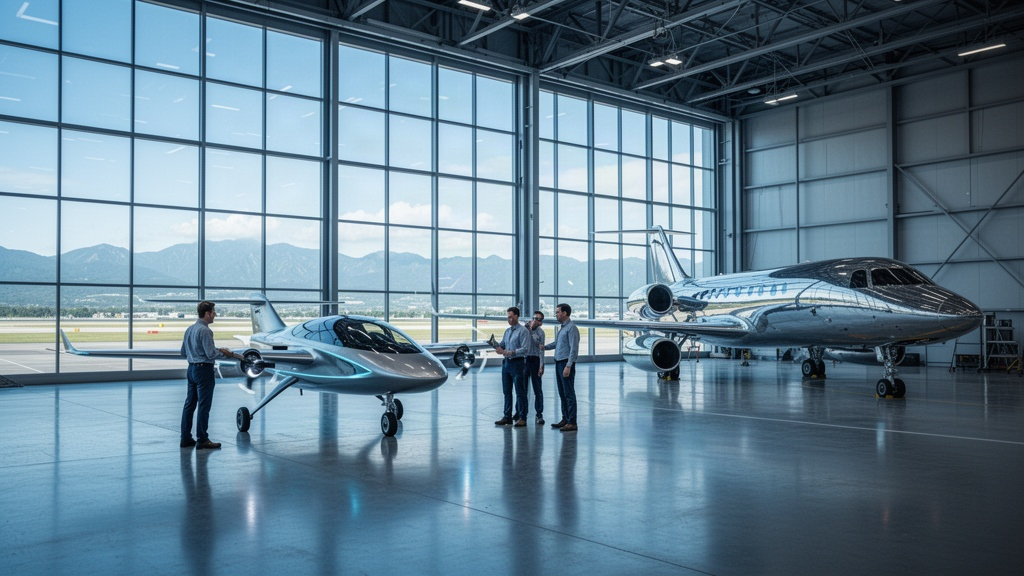
The flight industry stands at a crossroads unlike any it has faced before. Aerospace companies are no longer simply building faster or larger aircraft — they are rethinking propulsion systems, renegotiating their relationship with carbon emissions, and competing in entirely new market segments that did not exist a decade ago. From electric vertical takeoff vehicles to satellites that enable real-time climate monitoring, the breadth of transformation is striking. Sustainable Aviation Fuel (SAF), hybrid-electric architectures, and advanced digital tools are reshaping engineering workflows across the industry. Meanwhile, regulators at the FAA, EASA, and ICAO are updating certification frameworks to accommodate aircraft categories that challenge every assumption baked into legacy airworthiness rules. What drives this acceleration, and where does it lead?
Why aerospace companies are entering a new innovation cycle
Several forces have converged to make the current moment genuinely different from previous cycles of aircraft development. Climate pressure is the most visible. Aviation accounts for approximately 2.5% of global energy-related CO2 emissions according to IATA estimates, a figure that looks modest until you factor in non-CO2 warming effects at altitude. Airlines, under mounting pressure from regulators and investors alike, are pushing their suppliers to deliver cleaner technology faster than traditional development timelines allow.
At the same time, passenger demand has rebounded strongly after the disruptions of the early 2020s, and carriers are placing large aircraft orders again. Both Airbus and Boeing carry substantial backlogs, which creates a direct commercial incentive for manufacturers to deliver on next-generation programs rather than delay them indefinitely.
Industrial sovereignty has also entered the equation. Governments across North America, Europe, and the Asia-Pacific region are treating aerospace capability as a strategic asset, not merely an economic sector. Defense budgets are rising, space programs are expanding, and domestic supply chains are being restructured to reduce dependence on single-source components. This policy environment channels significant public funding into research programs at agencies like NASA Aeronautics, which actively partners with private companies on sustainable propulsion and autonomous systems.
Digitalization adds another layer. Engineering teams that once relied on physical prototypes now use digital twin technology to simulate aircraft behavior, predict maintenance needs, and reduce certification test campaigns. The result is shorter development cycles and lower unit costs — at least in theory. Translating that potential into actual production efficiency remains an ongoing challenge for the entire supply chain.
The technologies reshaping the future of flight
No single technology defines the current wave of aerospace innovation. Instead, several parallel streams are advancing simultaneously, each with its own maturity level and timeline to commercial deployment.
Read also: How Not to Ignore the Impact of Agriculture on Your Business
- Sustainable Aviation Fuel (SAF): produced from biomass, waste feedstocks, or synthetic processes, SAF can reduce lifecycle emissions compared to conventional jet fuel. IATA projects that SAF could contribute around 65% of the emissions reductions needed to reach net-zero by 2050, though production volumes remain far below what that trajectory requires.
- Hybrid-electric propulsion: architectures that combine a thermal engine or turbine with an electric drivetrain offer efficiency gains on shorter routes and open design possibilities for unconventional aircraft configurations.
- eVTOL aircraft: companies like Joby Aviation and Archer Aviation are developing electric vertical takeoff and landing vehicles for urban air mobility, targeting routes that ground transportation handles poorly.
- Artificial intelligence and digital twins: AI tools accelerate aerodynamic simulation, predictive maintenance, and supply chain planning, while digital twins allow engineers to monitor physical assets in real time.
- Advanced materials: next-generation composites and metal alloys reduce structural weight, cutting fuel burn across aircraft types regardless of the propulsion system used.
The interaction between these streams matters as much as any individual technology. An eVTOL aircraft running on electricity generated from renewable sources, maintained through predictive algorithms, and certified under updated FAA Part 23 rules represents a convergence of several innovation threads rather than a single breakthrough. That systemic quality makes aerospace progress harder to summarize but far more durable when it takes hold.
GE Aerospace and Rolls-Royce are both investing heavily in open-fan and hybrid-electric engine architectures, targeting fuel efficiency improvements that would be meaningful even without a full switch to alternative fuels. Meanwhile, RTX is advancing adaptive cycle engine technology for defense applications, with potential spillover benefits for commercial platforms.
How aerospace companies are decarbonizing aviation
IATA's net-zero CO2 target for 2050 sets the headline ambition for commercial aviation. Reaching it requires simultaneous progress on SAF scale-up, new aircraft technology, operational improvements, and carbon offsetting or capture mechanisms. No single lever is sufficient on its own.
CORSIA, the Carbon Offsetting and Reduction Scheme for International Aviation developed by ICAO, entered its pilot phase in 2021 and its first phase in 2024, with a second phase scheduled for 2027. The scheme requires airlines operating international routes to monitor, report, and offset emissions growth above a baseline. It does not cap total emissions but creates a financial incentive to reduce them and a framework for accountability.
SAF production is the area where the gap between ambition and reality is sharpest. Certification pathways exist, and the U.S. Department of Energy has set aggressive domestic production targets, but current global output covers only a small fraction of jet fuel demand. Scaling SAF requires investment across feedstock supply chains, refining infrastructure, and blending logistics — none of which happens quickly or cheaply.
Read also: Discover What Makes nasdaq: tsla a Unique Investment
Aircraft manufacturers are pursuing structural efficiency gains through aerodynamic refinement and weight reduction. Airbus has been testing wing flex configurations and laminar flow technology on demonstrator aircraft, while Boeing continues developing composite-intensive structures. These incremental improvements compound over time, but they do not replace the need for propulsion transformation on longer routes where electrification remains impractical with current battery energy density.
The honest picture is one of genuine progress constrained by physical and economic limits. The industry is moving in the right direction, but the pace of decarbonization depends heavily on policy support, infrastructure investment, and the willingness of airlines to pay a premium for cleaner operations.
From certification to commercial scale
Developing a promising technology and getting it into commercial service are two very different challenges. Type certification — the regulatory approval confirming that an aircraft design meets applicable safety and airworthiness requirements — can take years and involve thousands of hours of testing, analysis, and regulatory review. The FAA's Part 25 rules for transport-category aircraft and Part 23 for smaller aircraft set demanding standards that new entrants often underestimate.
For eVTOL manufacturers, the certification path is particularly complex because these aircraft do not fit neatly into existing categories. Both the FAA and EASA have developed specific frameworks for powered-lift aircraft, but applicants must still demonstrate compliance with safety standards that were not written with their configurations in mind. Certification timelines announced by companies have frequently shifted, reflecting the genuine difficulty of satisfying regulators on novel failure modes and redundancy requirements.
Supply chain capacity is a parallel constraint. Aerospace-grade components — whether composite structures, electric motors, battery management systems, or avionics — require qualified suppliers, strict quality controls, and long lead times. Ramping production from prototype quantities to commercial volumes exposes every weakness in the supply network. Both Airbus and Boeing have publicly acknowledged supply chain bottlenecks as a limiting factor on current delivery rates, and new entrants face the same structural challenge without the benefit of established supplier relationships.
Read also: The challenges faced by aerospace companies today
Infrastructure also shapes adoption speed. eVTOL operations require vertiport networks, charging infrastructure, and air traffic management integration that do not yet exist at meaningful scale. SAF requires dedicated storage and blending facilities at airports. Each new technology category carries its own infrastructure bill, which investors and governments must be willing to fund before commercial operations can begin.
The competitive landscape and what comes next
The aerospace sector has always involved a small number of dominant players, but the boundaries of competition are shifting. SpaceX and Blue Origin have transformed the launch market, driving down the cost of reaching orbit and enabling a new generation of commercial satellite constellations. Lockheed Martin and Northrop Grumman remain central to defense programs, including next-generation stealth aircraft and space systems, while also investing in adjacent civil technologies.
Start-ups occupy a different position than they did in previous decades. Access to private capital, advanced simulation software, and additive manufacturing has allowed companies like Joby and Archer to develop credible aircraft programs with teams far smaller than traditional aerospace programs would require. Their agility is real, though it does not eliminate the regulatory and production challenges that every new entrant eventually faces.
The most significant near-term competition may be less about aircraft type and more about data and services. Airlines increasingly value predictive maintenance contracts, flight operations software, and real-time connectivity over pure hardware performance. Manufacturers that build strong digital service businesses alongside their product lines will have recurring revenue streams that smooth out the cyclicality of new aircraft orders.
Watching where NASA's X-plane programs direct their research investment offers a reliable leading indicator of where commercial aerospace will focus in the following decade. The agency's work on transonic truss-braced wings and hybrid-electric regional aircraft points toward a future where efficiency gains come from rethinking the entire aircraft configuration rather than incrementally improving existing designs. That longer view is where the most consequential aerospace decisions are being made today.