Urban farming has moved well beyond rooftop gardens and community plots. Today it attracts serious venture capital, generates commercial-scale revenues, and sits at the intersection of food security, real estate innovation, and supply chain resilience. Founders are drawn by the promise of selling fresh produce directly to restaurants, retailers, and consumers within miles of production. The economics, though, are more demanding than the pitch decks suggest. Energy costs, zoning constraints, food safety obligations, and the sheer complexity of controlled growing environments create real barriers. Before signing a lease or ordering grow lights, every aspiring urban farm operator needs a clear-eyed view of what the business actually requires. This guide covers the production models, financial mechanics, regulatory landscape, and demand-validation steps that separate sustainable ventures from expensive experiments.
Why urban farming attracts founders—and where the opportunity really lies
Proximity to consumers is the single most compelling structural advantage urban farms hold over conventional agriculture. A greenhouse in a city warehouse can deliver leafy greens to a restaurant kitchen within hours of harvest. That freshness premium is real, and some buyers will pay for it. Supply chain disruptions experienced during the early 2020s made food sourcing fragility visible to institutional buyers who had previously ignored it, opening doors for local producers that would have been closed a decade earlier.
The opportunity is not uniform across all crops or all cities. High-value, short-cycle crops such as microgreens, specialty herbs, and baby salad leaves fit the urban model well because they turn over quickly, command strong per-pound prices, and can be grown in compact vertical systems. Staple crops like wheat, corn, or potatoes are economically unviable indoors at any meaningful scale given current energy prices.
Restaurants, grocery retailers, and institutional buyers increasingly want documented traceability and consistent year-round supply. An urban farm that can guarantee both has a genuine competitive position. The challenge is that this market is also growing more crowded. Several well-funded vertical farm operators have already entered major metros, and some have restructured or closed after discovering their unit economics did not hold at scale.
The realistic opportunity lies in specific niches: supplying a defined cluster of premium restaurants, running a direct-to-consumer subscription, or partnering with a grocery chain that wants a local sourcing story. Broad, undifferentiated production is the riskiest path. Founders who identify a committed buyer before building anything consistently outperform those who grow first and sell later.
Choose the right production model before investing
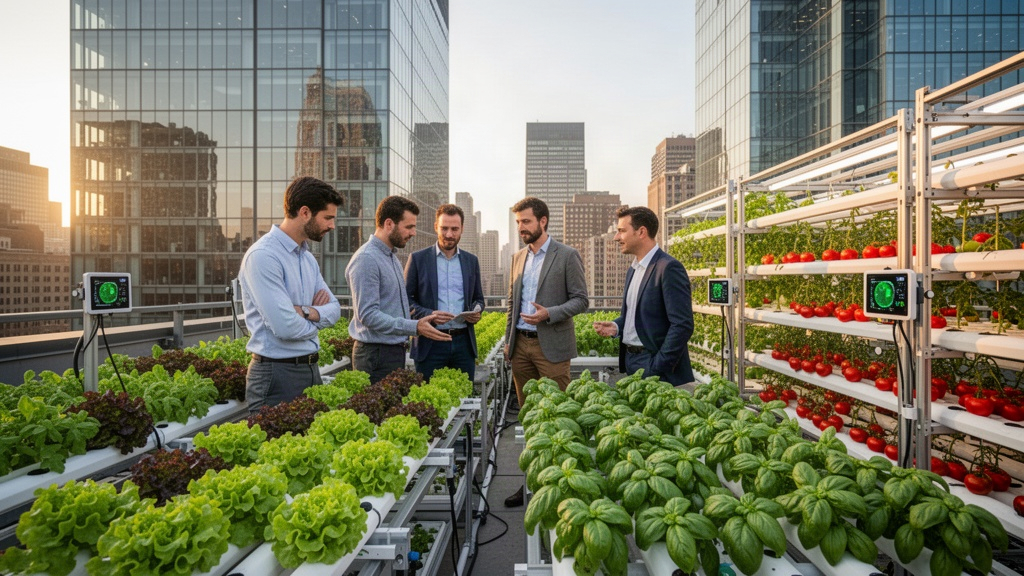
The production model determines almost everything else: capital requirements, energy bills, regulatory complexity, and which crops are viable. The table below compares the five most common formats.
Read also: Exploring SandP500's Role in Economic Forecasting for 2026
| Model | Infrastructure required | Energy intensity | Land footprint | Environmental control | Suitable crops | Regulatory complexity | Primary economic risk |
|---|---|---|---|---|---|---|---|
| Rooftop farm | Structural assessment, waterproofing, raised beds | Low to moderate | Uses existing roof space | Minimal (outdoor) | Herbs, salad, tomatoes | Moderate (building permits, load limits) | Seasonal gaps, weather exposure |
| Greenhouse | Steel or polycarbonate structure, heating, ventilation | Moderate | Ground-level or rooftop | Partial (natural light supplemented) | Tomatoes, cucumbers, herbs, flowers | Moderate (zoning, planning consent) | Heating costs in cold climates |
| Indoor vertical farm | Racking systems, LED lighting, HVAC, hydroponics | High | Compact (multi-layer) | Full (CEA) | Leafy greens, herbs, microgreens | High (food safety, electrical, water) | Energy cost volatility |
| Container farm | Retrofitted shipping container, integrated systems | High | Very small | Full | Microgreens, herbs, salad | Variable (siting, utility connections) | High capex per unit of output |
| Hydroponic facility | Grow channels, nutrient dosing, water filtration | Moderate to high | Flexible | High (nutrient and pH control) | Lettuce, basil, strawberries | Moderate to high (water discharge rules) | System failure, crop loss risk |
Indoor vertical farms and container farms offer the highest degree of environmental control through controlled environment agriculture (CEA), but they carry the highest energy burden. A facility relying entirely on artificial LED lighting will see electricity appear as one of its largest operating costs, and that exposure increases with energy price volatility. Greenhouses mitigate this by using natural light, accepting some seasonal variation in exchange for lower bills.
Aquaponics adds another layer by combining fish cultivation with plant production, using fish waste as a nutrient source after biological conversion. The model is compelling on paper but operationally complex: two biological systems must be kept in balance simultaneously, and a fish health event can wipe out both revenue streams at once.
Build the business case around unit economics
The most common financial mistake in this sector is projecting revenue from production capacity without stress-testing the cost side. Unit economics — the margin on each pound or kilogram sold — must be positive before any scaling decision makes sense.
On the cost side, the main buckets are: facility rent or mortgage, energy (lighting, HVAC, water pumping), labor, nutrients and growing media, packaging, distribution, and equipment depreciation. Labor and energy together typically account for the largest share of variable costs in indoor operations. Automation can reduce labor over time, but the capital investment required is significant and must be amortized.
Revenue depends on crop selection, sales channel, and pricing power. Direct sales to restaurants or via a community-supported agriculture (CSA) subscription generally yield better margins than selling through a distributor, which will take a percentage and impose volume and consistency requirements. Pricing is local: what a specialty grocery in a dense urban neighborhood pays per pound of living basil will differ substantially from what a regional distributor offers.
Read also: Discover How Vxus Can Transform Your Business Strategy
Founders should build three financial scenarios before committing capital: a base case using conservative yield and price assumptions, a downside case assuming 20–30% lower yields or prices, and an energy-shock scenario. If the downside case produces unrecoverable losses, the capital structure needs adjustment before launch. The U.S. Small Business Administration provides free business planning templates and counseling through its SCORE network, which can be useful for stress-testing assumptions with an experienced advisor.
Navigate permits, food safety, and site constraints
Regulatory requirements vary significantly between cities, states, and countries. There is no single permit checklist that applies across the English-speaking market. Before signing any lease, operators must verify zoning classification with the local planning authority: agricultural or food production use is not automatically permitted in industrial, commercial, or mixed-use zones.
In the United States, farms above certain revenue thresholds may fall under the FDA Food Safety Modernization Act (FSMA), which imposes requirements around water quality testing, worker hygiene, equipment sanitation, traceability records, and recall procedures. Smaller operations may qualify for exemptions, but those exemptions have conditions that must be verified directly with the FDA or a qualified food safety consultant.
In the United Kingdom, producers must register with their local authority environmental health department before selling food commercially. The Food Standards Agency sets the broader framework for hygiene standards, labeling, and traceability. Defra handles broader agricultural and environmental policy, including rules on water abstraction and discharge that can affect hydroponic and aquaponic systems.
Building permits, electrical upgrades for high-amperage grow lighting, structural assessments for rooftop loads, and water discharge approvals each involve separate agencies and separate timelines. Attempting to run these processes in parallel rather than sequentially can save months. Budget for professional help: a food safety consultant and a planning attorney or agent will pay for themselves by avoiding costly retrofits or enforcement actions.
Read also: How to Invest in Stocks: Your Journey to Wealth Creation
Validate demand before scaling the operation
Many urban farm ventures have failed not because the growing system underperformed, but because the market was smaller or more price-sensitive than the founders assumed. Demand validation before capital deployment is the discipline that separates durable businesses from well-intentioned experiments.
The practical approach starts with direct conversations, not surveys. Sit down with the chefs, buyers, or retailers you plan to sell to. Ask what they currently pay, who supplies them, what problems they have with that supply, and whether a local alternative at a specific price point would actually change their buying behavior. Pre-orders or letters of intent from two or three committed buyers carry more weight than a market sizing exercise built from industry reports.
Run a pilot before building full capacity. A small container farm or a single greenhouse bay can generate real sales data on pricing, volume consistency, and buyer retention at a fraction of the cost of a full facility. Track cost per kilogram produced, actual selling price, and buyer reorder rates from week one. These metrics will tell you whether the unit economics work in practice, not just in a spreadsheet.
Crop selection should follow buyer demand, not growing convenience. If your target restaurant group wants year-round shishito peppers and edible flowers, that requirement shapes your production system, not the other way around. Founders who let customer contracts drive crop decisions build more defensible businesses than those who grow what the system makes easiest and then search for buyers afterward.
Set explicit decision criteria before launch: a minimum revenue threshold to reach within six months, a maximum acceptable cost per unit, a reorder rate that signals genuine buyer satisfaction. If those thresholds are not met, the data points to a specific problem — pricing, crop mix, distribution, or production cost — rather than leaving founders guessing. Disciplined iteration on a small scale is far less expensive than discovering the same problems after building a full facility.